Showing posts with label Jerry Dodrill. Show all posts

Tuesday, November 4, 2014

This Side of Paradise


In January of 2006 I walked out to the Bardini Boulders near Bishop, CA, to take some photos of Kevin Jorgeson doing the 3rd ascent of a very challenging boulder problem called "This Side of Paradise" (V10). He needed a bunch of crash pads to do this with relative safety, so we rallied together a few friends to help. Brad Parker was a close friend of ours and was then the resident host of a dirtbag climber camp called "The Pit." He had a lot of pads, or knew people who did, so he became a key player in making the mission happen. Kevin had been working out the moves and by the time he was finally ready to start the climb we were all anxiously chewing our fingernails.
The crux is up high, and even if you do have a foot of foam below you, you don't want to blow it. He finally got psyched up and began pulling on holds with the precision of a finely tuned machine. A spotter wasn't really going to help if you fell from the crux, and I didn't want anyone in the photos except Kevin. At a certain point Brad was supposed to run in and rearrange the pads, then get out of the way so if Kevin fell he didn't drive him into the ground like a nail. He did his job perfectly but as he started to walk away Kevin yelled nervously down: "Spot Me!" So there was Brad, reaching up, hoping he wouldn't have to pluck Kevin out of the sky.
Looking back nearly nine years later, I can see the metaphor in this image. In one way or another, Brad was always spotting people when they were run out and in epic situations on the rock and in life. He surrounded himself with a community of reliable people who were able to achieve more than they ever thought possible, and would be ready and able to catch a falling friend. With Brad's strength beneath him, Kevin felt confident enough to fire through the crux. His success on this scenic climb was inspiring and we all stepped up to achieve even bigger dreams and goals. So it is with great disbelief and sadness that we come to terms with the fact that Brad left this Earth in the Yosemite Highcountry this past summer. He fell while soloing the easy South-North Traverse on Matthes Crest. Though his strong hands will never again reach for our backs, we will forever hold him in our hearts.

-Jerry Dodrill

To learn about the Brad Parker Memorial Fund, visit: https://www.facebook.com/bradparkermemorialfund

Follow Kevin Jorgeson and his massive Dawn Wall project here: http://www.kevinjorgeson.com/je8d17tfu61fbnpiwo4a0lz9ldvj2y


Thursday, May 8, 2014

Eureka Dunes, Death Valley Trip Report

The suspension on my wife's VW Jetta was getting a real stress test as I bouncing through brain-jarring wash board on Eureka Valley road in Death Valley National Park. The rocky ten mile long track is known for shredding tires and is probably best suited to 4x4 trucks. I'll probably be in trouble when she reads this, because before leaving I had promised I wouldn't leave the pavement.

On my previous four wildflower photo trips to Death Valley I had been skunked by drought conditions, and the timing of infrequent storms did not produce good results. My expectations were probably unrealistically high considering that the first two visits to the park were in 1998, and 2005, both of which were "once in a lifetime" El Nino blooms. So when I saw a friend's photos online I knew I had to act immediately. Like a California ice climber, the photographer's best piece of equipment is a fast car. The blooms are ephemeral and won't wait for late comers.


Eureka Dunes, one of the largest in the US, is in the remote northern section of Death Valley and best accessed from Big Pine in the Owens Valley. The drive from where I live in Sonoma County is about ten hours and I only about 36 hours to get there and back. I loaded the car friday evening and left the house first thing Saturday with wife and dog in tow. We had to drop off some prints at Mountain Light Gallery in Bishop, so did that and got a hotel Saturday night. The next morning I got up early and drove alone out to the dunes while Arienne caught up on sleep. I'd only have a couple hours to make images.


The sunrise came and went as I bounced along the road at an agonizingly slow pace. Ga-dunk, ga-dunk, ga-dunk! The drive was tedious but when the fields of flowers began appearing around me I knew it was worthwhile. The desert was alive!

Fortunately there was some cloud cover, so the sun didn't just glare into the scene with a bald sky. This gave some precious time to find a few nice landscapes where the plant densities were most concentrated, and I knew there would be time to shoot closeups after the clouds blew over.


I was frantically wandering around vast fields of flowers, with stunning beauty in every direction. While this may sound blissful, it actually caused a fair a bit of stress because I was short on time and the light was changing fast. I had to tear myself away from some beautiful scenes because it just wasn't possible to take every shot. All too soon the time was up.
The drive back on the terrible road seemed to take even longer now, because I was running late. Finally I hit the pavement and hauled ass back up over the pass, enjoying a magnificent view of the Palisades and Sierra Crest as I sped toward home. This was my first trip to this part of Death Valley and I'm sure I'll be back to spend more time at a less hurried pace.

-Jerry Dodrill

Monday, December 10, 2012

Rotation180º Preview at PhotoPlus Expo

At the 2012 PhotoPlus Expo in New York, Damon Webster of Photoinduced.com asked me to give him a demo of the new Rotation180º photo daypack. We had just unveiled MindShift Gear to the public and were stationed in the corner of the Think Tank Photo booth. Hurricane Sandy was bearing down on Manhatten and there was a lot of energy in the exhibit hall. Here's my off the cuff pitch of the pack's primary features.


You can support the effort to launch MindShift Gear by backing our Rotation180º project on Kickstarter.com.

Thursday, December 6, 2012

MindShift Gear Launches Rotation180º pack on Kickstarter


For my entire career I've preferred photo waist packs as my primary bags for landscape and climbing photography. Often enough its just not feasible to put all my camera gear on the ground to access it. I used the old Galen Rowell/FotoFlex waist pack for years. It worked like a portable workbench mounted on my hips. When it wore out I used LowePro's Orion AW. I blew out the seams on that and have since been using Think Tank Photo's burly SpeedRacer. These have worked great for shooting but don't support a tripod or allow for all the other stuff I need to take on a day of photographing in poor weather or when teaching workshops in remote places. Photo backpacks are perfectly fine for getting to a location but not very convenient as a bag from which you actually shoot in wild environments. So lately I've been fortunate to work alongside conservation photographer Daniel Beltrá and the amazing designers at Think Tank Photo to help develop an innovative solution. Our result is a ground breaking new photo daypack that I'm really happy with. After several years of work the testing and design is finally complete for our new Rotation180º Professional pack. I’ll post some more photos and a detailed preview of features shortly.


We have put together a new company called MindShift Gear to design this and other innovative photo products for outdoor adventure and conservation photographers.  Our primary startup team is Doug Murdoch and Mike Sturm, co-founders of Think Tank Photo and designers with 25 years of experience, conservation photographer Daniel Beltrá, marketing whiz Brian Erwin, and myself. We would be sunk without the help of graphic designer Larry Atil and Doug Bush for customer service. There are a number of other great folks who have supported us in SO many ways and without their patience this would never have happened. Thanks!

Back in October Daniel and I went to New York and unveiled the Rotation180º at the PhotoPlus Expo. It was a big hit and we received great feedback from photographers. On Monday, December 3rd, we launched a month long Kickstarter.com crowd-sourced fund raising campaign to enable us to produce the first run of bags. Its gotten off to an amazing start for the first few days and we have been astounded at the response from the photo community. We reached our minimum funding goal in just thirteen hours and after a couple days have reached more than 200% of our goal. I hope you will take a look and consider helping us make this a reality by pledging to receive one of the first edition packs and sharing the project with your friends.


For more info, Here is an interview Daniel and I did on Geekbeat.tv in New York at the PhotoPlus Expo.

Cheers,
-Jerry Dodrill

Friday, September 16, 2011

Red Tide

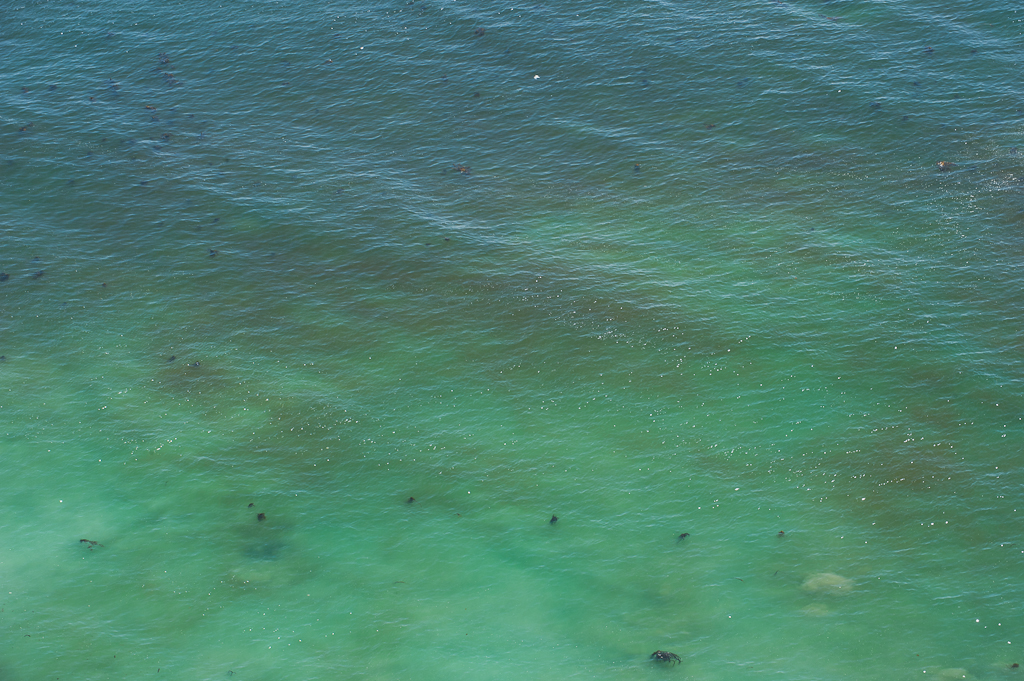
A few weeks ago I was driving up the grade on Highway 1 north of Jenner on the Sonoma Coast. Just before dropping down toward Fort Ross the morning fog broke away and I was aghast at the sight of the ocean. It looked like a biblical prophecy had been fulfilled; the water had turned to blood.
At the first chance I swerved into a pull out and got out the camera. Was it a major oil spill like the Deepwater Horizon? No, it was the most extensive red tide ever seen on the Sonoma Coast, and its effect on the salt water ecosystem has been devestating. 

A red tide is a harmful algal bloom of dinoflagellate plankton that occurs when ocean conditions are warm and calm. It can contain a neurotoxin that poisons, suffocates and kills shell fish. This same little plankton also causes a wonderful display of bioluminescence that I photographed last november. While red tides are not uncommon, some sources suggest that this year's El Nino event, warming sea water temperatures, fertilizers, and pollution may have contributed to severity of the current event.  
Within a week vast numbers of red abalone, mussels, sea urchins, sea stars and other invertebrates began washing up on Sonoma County shorelines. The major die-off is like nothing ever seen here and yesterday prompted the California Department of Fish and Game to enact an emergency action to close the 2011 abalone fishing season. 
 

Yesterday, September 15, I returned to Salt Point State Park, and walked cove after cove of rugged shoreline. Normally I am excited to find a single perfectly shaped shell on the beach, but there is no joy in discovering large mounds of skeletons - the bones of our delicate oceanic neighbors. 

For more information visit the Department of Fish and Game website.
© 2011 Jerry Dodrill Photography

Wednesday, March 2, 2011

Horsetail Fall

I was still in the womb when Galen Rowell made his iconic 1973 image of Last Light on Horsetail Fall. Often imitated, rarely rivaled, photographers flock to Yosemite Valley each February to re-create images of this now famous natural optical phenomena. After spending several years working for Mr. Rowell I knew better than to go around copying his work so had made no attempts to photograph Horsetail. Galen was tragically killed in 2002 and now I feel a certain nostalgia about revisiting the places which defined his career. In February I stopped for the first time along Northside Drive and stood shoulder to shoulder with 60-70 others waiting for the light. When it peaked out through the clouds just before sunset a hushed reverence settled over the crowd, a thousand clicks reverberated through the air and the legacy of a visionary's spirit was channeled through another generation of landscape photographers.

Thursday, July 22, 2010

End of the Road: New Idria


My wife and I were relaxing at Mercey Hot Springs in the Panoche Hills south of Mt. Diablo. I’m not very good at vacation and was scanning the map to eek out an adventure. Thirty miles away the road enticingly ended at “New Idria.” Those words were familiar. I’d read an account of this place in a book called Up and Down California in 1860-1864, the Journal of William H Brewer. Mr. Brewer was part Josiah Whitney's California Geologic Survey. In 1861 they journeyed to New Idria quicksilver mine on horseback:

"The view is extensive and peculiar... the Panoche Plain, with the mountains beyond–chain after chain of mountains, most barren and desolate. No words can describe it...gray and dry rocks or soil, furrowed by ancient streams into innumerable canyons, now perfectly dry, without a tree, scarcely a shrub or other vegetation–none, absolutely, could be seen. It was a scene of unmixed desolation, more terrible for a stranger to be lost in than even the snows and glaciers of the alps.”


Intrigued, Arienne and I spent the afternoon driving out the neglected road, stepping back in time, enjoying the vast openness, eventually winding our way up into the stark mountains.


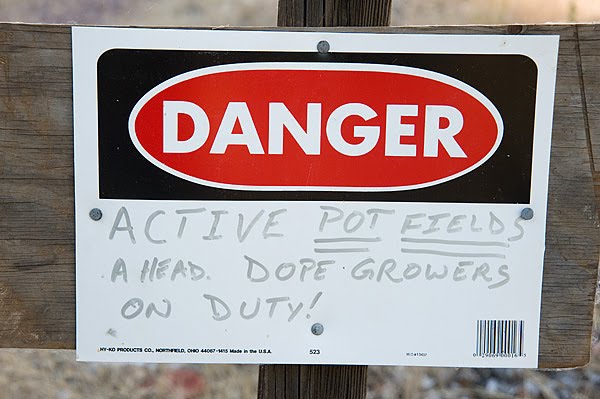
The road passed a number of ranches, turned to dirt and got steep before we finally we came to the Idria ghost town where the sign read:“Welcome to New Idria. Population: Me.” There were some other interesting signs as well. We had been told that despite the intimidation the road was public access and the often gun-weilding care-taker didn't have authority to run us off. (Though I don't tend to argue with flying bullets.)

This last sign was probably the greatest deterrent of them all.

There wasn’t a soul to be seen so we poked around a little bit, trying to avoid touching anything or breathing in the foul stench. There was a bad vibe in the air and it felt like something really terrible had happened here. The long bunk houses were trashed and filled with junk, windows smashed, doors kicked in, rats running around everywhere. The smell was horrendous. Arienne was smart enough to stay outside but I was fascinated by what looked like the set of a horror flick and ventured in for a moment.


Early Mexican, Chilean, Irish and Cornish migrant laborers earned just a couple dollars a day doing very dangerous jobs in the mine. Brewer wrote:

“Sulphurous acids, arsenic, vapors of mercury, etc., make a horrible atmosphere, which tells fearfully on the health of the workmen, but the wages always command men and there is no want of hands...”


The mine ceased production in 1972 and is now in a complicated state of bureaucracy between environmentalists, historians, government, and the current owner. The site has the unique distinction of being both a federal EPA Super Fund cleanup site and a California State Historical Site. The buildings are infected with the deadly hanta virus and need to be burned down, yet because of the historic status this cannot be done.
Just to add more complications, the Sierra Club has found some endangered species nearby, and the ground in the mountains is composed of asbestos, covered with poison oak, and crawling with rattlesnakes.

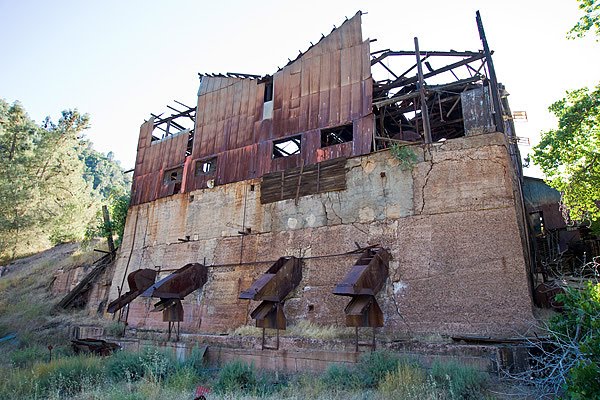
Rotary furnace building, built in 1917.
The website new-idria.org puts the situation in perspective:

"The New Idria Mercury Mine, the world's fourth largest quicksilver mine, became listed in the EPA's Comprehensive Environmental Response, Compensation, and Liability Information System (CERCLIS) database on April 16, 1996 because of the many complex environmental issues associated with this property's legacy as 115 years as a cinnabar mine and a mercury processing plant.

While there has been a good deal of study and concern about the pollution and contamination problems at New Idria, little has been done to begin remediation because the property owners lack the funds necessary for the environmental cleanup and hazard remediation. Regrettably, with several concerned environmental groups waiting in the litigation wings, it is doubtful that any well-off investor will purchase the property simply because litigation will begin the day after escrow closes."


New Idria was once a beacon of wealth and prosperity. But like other more current environmental disasters, the investors who prosper are quick to vanish leaving the aftermath for future generations. Brewer was accurate when he wrote:

“Such is New Idria and by such toils and sufferings do capitalists increase their wealth.”


-Jerry Dodrill

_____________________


For more info about New Idria: http://www.new-idria.org/

For a fascinating read about California history after the gold rush and during the civil war read:

Up and Down California in 1860-1864; The Journal of William H. Brewer


Jerry Dodrill

www.jerrydodrill.com

Wednesday, March 18, 2009

Desolation Skiing


A few friends and I took off for a little excursion to Desolation Wilderness this past weekend. Berghorn and I skied in on Friday morning after getting a wilderness permit and sorting out the parking situation with the US Forest Circus, CHP, and some sheriffs officers who thought we were up to no good. Eric warded them off at the back of the car while I talked to CHP on my cell phone in the front seat. Nobody really knew what to tell us, and we ended up just parking along the road (the parking lot is closed all winter - brilliant). If it were to start snowing, we would be towed! Luckily, it didn't. The Forest Service hadn't issued a single wilderness permit this winter for the Pyramid Creek Trailhead at Twin Bridges, across from Lover's Leap. So virtually none of the snow was tracked.

Digging camp on a warm, windless day after skinning up the steep brushy slopes.
Meanwhile, Andrew and The Chiz were skiing in. Eric (Chisholm) brought a massage table up the hill with him, okay, not really, but we wished he had. They got to camp and we had a nice dinner.

Next morning the weather changed. Wind and clouds, and we were nervous about getting towed if it started snowing, which was in the forecast for the afternoon. Eric made breakfast, some amazing pancakes from scratch, and we watched the clouds.

After a while it started clearing up. Chisholm held down camp while the rest of us headed toward Pyramid Peak.


Weather was windy and funky, so we blew off the summit and headed down the awesome east slopes. Andrew dropping in...

Crossing bear tracks

Gunning it for camp

Andrew was pretty psyched on his new split board, hit the steeps and caused a little slider on the last drop. Luckily, we didn't have to use our avalanche beacons.

The weather was supposed to come in overnight and we didn't want to drive to Placerville to pick up our car from the impound, so we blasted out and caught climbing legend Fred Becky's slide show in South Lake. Good times indeed!

Whipped boys watching tv in the hotel after a great couple days schlepping loads up and down the hills. Next time we'll forgo he packs and blast it in a day.


Motivate...

Instigate...

-Jerry
http://www.jerrydodrill.com