Thursday, December 6, 2012

MindShift Gear Launches Rotation180º pack on Kickstarter


For my entire career I've preferred photo waist packs as my primary bags for landscape and climbing photography. Often enough its just not feasible to put all my camera gear on the ground to access it. I used the old Galen Rowell/FotoFlex waist pack for years. It worked like a portable workbench mounted on my hips. When it wore out I used LowePro's Orion AW. I blew out the seams on that and have since been using Think Tank Photo's burly SpeedRacer. These have worked great for shooting but don't support a tripod or allow for all the other stuff I need to take on a day of photographing in poor weather or when teaching workshops in remote places. Photo backpacks are perfectly fine for getting to a location but not very convenient as a bag from which you actually shoot in wild environments. So lately I've been fortunate to work alongside conservation photographer Daniel Beltrá and the amazing designers at Think Tank Photo to help develop an innovative solution. Our result is a ground breaking new photo daypack that I'm really happy with. After several years of work the testing and design is finally complete for our new Rotation180º Professional pack. I’ll post some more photos and a detailed preview of features shortly.


We have put together a new company called MindShift Gear to design this and other innovative photo products for outdoor adventure and conservation photographers.  Our primary startup team is Doug Murdoch and Mike Sturm, co-founders of Think Tank Photo and designers with 25 years of experience, conservation photographer Daniel Beltrá, marketing whiz Brian Erwin, and myself. We would be sunk without the help of graphic designer Larry Atil and Doug Bush for customer service. There are a number of other great folks who have supported us in SO many ways and without their patience this would never have happened. Thanks!

Back in October Daniel and I went to New York and unveiled the Rotation180º at the PhotoPlus Expo. It was a big hit and we received great feedback from photographers. On Monday, December 3rd, we launched a month long Kickstarter.com crowd-sourced fund raising campaign to enable us to produce the first run of bags. Its gotten off to an amazing start for the first few days and we have been astounded at the response from the photo community. We reached our minimum funding goal in just thirteen hours and after a couple days have reached more than 200% of our goal. I hope you will take a look and consider helping us make this a reality by pledging to receive one of the first edition packs and sharing the project with your friends.


For more info, Here is an interview Daniel and I did on Geekbeat.tv in New York at the PhotoPlus Expo.

Cheers,
-Jerry Dodrill

Saturday, July 7, 2012

Into the Trees, Zoë Keating

A couple years ago I had the opportunity to photograph avant cellist Zoë Keating in a redwood forest near her home in Occidental. The images were for her album "Into the Trees." Her work is incredibly inspiring and has been playing in my car or ipod while making many many images. This morning I ran a cross a video of her performing Lost and was reminded of this image below an old growth redwood that you could live in if indeed you were lost in the woods. It was a bit theatrical for the album but was one of my favorite images from the shoot.


Visit Zoë's website: http://www.zoekeating.com/

Cheers,
Jerry Dodrill


Friday, September 16, 2011

Red Tide

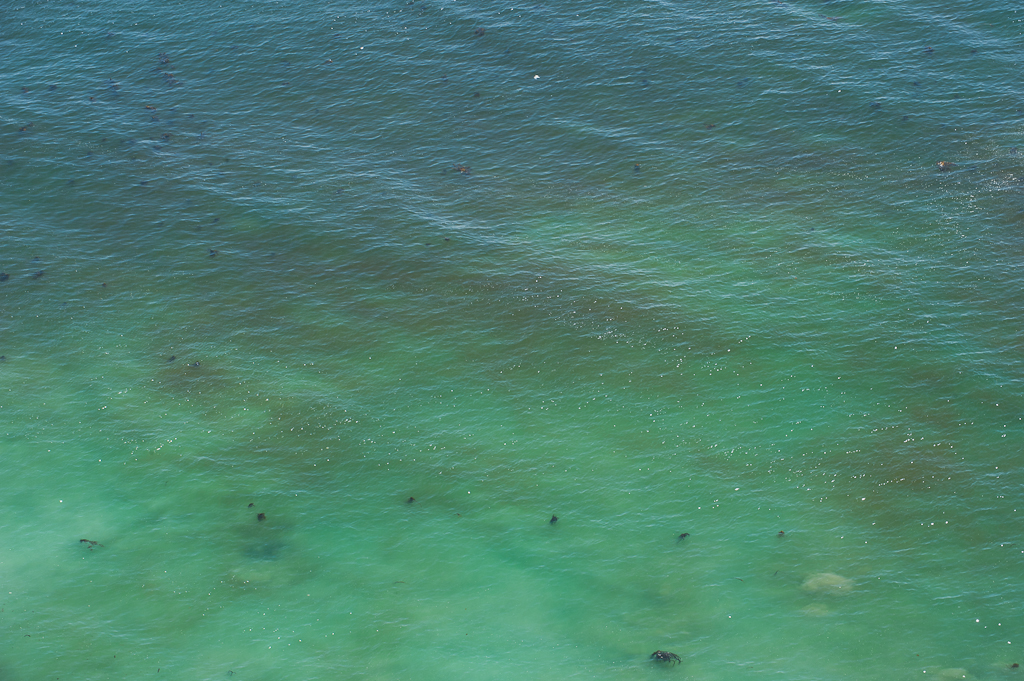
A few weeks ago I was driving up the grade on Highway 1 north of Jenner on the Sonoma Coast. Just before dropping down toward Fort Ross the morning fog broke away and I was aghast at the sight of the ocean. It looked like a biblical prophecy had been fulfilled; the water had turned to blood.
At the first chance I swerved into a pull out and got out the camera. Was it a major oil spill like the Deepwater Horizon? No, it was the most extensive red tide ever seen on the Sonoma Coast, and its effect on the salt water ecosystem has been devestating. 

A red tide is a harmful algal bloom of dinoflagellate plankton that occurs when ocean conditions are warm and calm. It can contain a neurotoxin that poisons, suffocates and kills shell fish. This same little plankton also causes a wonderful display of bioluminescence that I photographed last november. While red tides are not uncommon, some sources suggest that this year's El Nino event, warming sea water temperatures, fertilizers, and pollution may have contributed to severity of the current event.  
Within a week vast numbers of red abalone, mussels, sea urchins, sea stars and other invertebrates began washing up on Sonoma County shorelines. The major die-off is like nothing ever seen here and yesterday prompted the California Department of Fish and Game to enact an emergency action to close the 2011 abalone fishing season. 
 

Yesterday, September 15, I returned to Salt Point State Park, and walked cove after cove of rugged shoreline. Normally I am excited to find a single perfectly shaped shell on the beach, but there is no joy in discovering large mounds of skeletons - the bones of our delicate oceanic neighbors. 

For more information visit the Department of Fish and Game website.
© 2011 Jerry Dodrill Photography

Saturday, July 9, 2011

Little Things

As a long time Nikon user I’ve been super happy with most of the features of my SLRs. But I have to admit there is one feature that my companions who use Canon have that I have been jealous of, or I was jealous until last week. 
In the effort to get tack sharp images I go through a series of steps to minimize vibration: Be sure my tripod feet are firmly planted, avoid using a center column, set the camera to lock up the mirror before releasing the shutter, and use a remote shutter release. There are many things that can cause vibration, but finger movement and camera vibration from the action of an SLR's spring-loaded mirror during slow exposures are most often to blame. Even the slightest image blur can make an exposure unusable for printing or publication.


It seems that I’m often working quickly to set up a composition as the light changes and in the hustle the remote release is somewhere in my bag or car that I just can’t find or be bothered to take the time to get out. I press the shutter release once and the mirror locks up. Then I’m ready to take the photo and try ever so softly to touch the button just hard enough to take the picture without vibrating the camera with my finger. I can’t set the camera for both mirror-lock up AND a shutter delay like my friends with Canon cameras. Or thats what I thought until I discussed the matter with a young photography workshop student at Lake Tahoe who told me to just turn on “Exposure delay mode.” HUH?! 
I’d seen this setting deeply buried in Nikon’s vast menu but hadn’t checked to see what it did. I mean, why would I want to delay taking an exposure? Here’s why:
Duh! I looked at the student incredulously, realizing how happy I was to be introduced to this simple little setting. I immediately saved it into the “My Menu” folder to access it easily. I will still prefer to use my remote release, but forgetting it will be one less thing on my mind in the field.
You’d think one day I’d actually read the owner’s manual... Sheesh! It just goes to show, every day is a school day. The learning process is a truly an incredible experience and the student will always be the teacher! 
Happy shooting!
Jerry Dodrill


Wednesday, March 2, 2011

Horsetail Fall

I was still in the womb when Galen Rowell made his iconic 1973 image of Last Light on Horsetail Fall. Often imitated, rarely rivaled, photographers flock to Yosemite Valley each February to re-create images of this now famous natural optical phenomena. After spending several years working for Mr. Rowell I knew better than to go around copying his work so had made no attempts to photograph Horsetail. Galen was tragically killed in 2002 and now I feel a certain nostalgia about revisiting the places which defined his career. In February I stopped for the first time along Northside Drive and stood shoulder to shoulder with 60-70 others waiting for the light. When it peaked out through the clouds just before sunset a hushed reverence settled over the crowd, a thousand clicks reverberated through the air and the legacy of a visionary's spirit was channeled through another generation of landscape photographers.

Tuesday, November 23, 2010

Bioluminescence


For years I’ve heard unbelievable stories about people’s surreal night time experiences in the ocean with glowing plankton blooms, but until recently I’d never seen it myself. The tip off came from Ellen Cruz, a friend from Bodega Bay who sent a note about an experience she’d just had on the coast:

...the ocean was illuminated as if under a black light...so awesome, cannot describe in words...no need to drop acid on this one...every white particle of wave was iridescent, florescent, glowing like you can't believe...step on the sand and your footprint glows and sparkles... there were banks of waves coming in, white caps in the distance just glowed, and when the waves connected it was elongated strips of fluorescent green stripes across the water... whew...

This strange oceanic occurrence is likely the root of ghost stories told by early sailors who saw the mysterious green fire in the water but failed to comprehend what they were seeing. Documented as far back as 500 B.C., most bioluminescent light occurs in tiny plants called dinoflagellates which live in the sea and gain energy from the photosynthesis of sunlight. In darkness they emit a blue light in response to movement within the water. The intensity of the light peaks about two hours after dark and is simply amazing to watch. During the day they turn red and can be the source of the neurotoxin that poisons shell fish during Red Tides.

After receiving Ellen’s note, and being somewhat fascinated by natural optical phenomena, my mind immediately began pre-visualizing how I could make an interesting photograph. I often try to imagine best-case situations that might occur in nature. The trick is to carefully consider the conditions which would be necessary for a scenario to occur and then consciously reverse engineer it and attempt to put yourself on location at just the right time while being prepared to capture the moment. Something magical often ends up happening, even if it is somewhat different than what you had imagined.

As I pondered the complexity of making an evocative image of the psychedelic tides I felt that the images would look very alien if there wasn’t an earthly land form with which the viewer can easily identify. I started piecing together two ideas that I thought I could achieve in the same night. I’d seen the first sliver of a moon the night before, just after sunset, and knew that the next day it would be about fifty minutes higher in the sky. So I wanted to first make an image of the crescent moon setting at twilight above the breakers and Arched Rock near Jenner. The second image I was visualizing was a long exposure at the cusp of night where I would have just enough light to see the arch, and enough darkness for the dinoflagellates to show up in the water.

I checked the wunderground.com weather satellite which showed crystal clear skies, then double checked the angle of the moon relative to the arch by using a very useful software for such things called The Photographer’s Ephemeris. All the elements seemed to align and it looked like a promising evening.
I pulled up at Goat Rock Beach in Sonoma Coast State Park right about sunset, (which-oops!- is when the Park closes), geared up in rubber boots and wind gear and headed south down Blind Beach in gorgeous light that I would normally have been shooting. This time I was on a mission for something more mysterious than a sunset but at one point I did stop and made a few exposures of boney rocks protruding from the sand with crazy beams of light coming over the horizon. This was an early and unexpected bonus shot. As the light diminished I came to where the convergence of the setting moon and the sea arch were just perfect.
The first set of images were exactly what I expected. In years past I’d made similar images here with the full moon setting at sunrise into the Earth’s shadow. What I didn’t expect this time is that my camera’s sensor was picking up the Milky Way directly above the Arch! This added a layer of intrigue to the image that was far beyond what I’d imagined. Soon the starry night was fully visible to the naked eye.

If the moon had been larger or higher I believe its light would have polluted the clear, cold night sky and blown out the reflection in the water. But it was just slight enough that the relative contrast between the starlight and reflections fell into a range which could be handled if I was careful. But it was the bioluminescence that was most incredible. Each waved rolled in looking like a million neon glow sticks had been dumped into them. The blue-green light shot across the breakers as they crashed, the more wave energy released, the more light emitted. The backwash on the beach left momentary trails of light which resembled a million little galaxies.
I was in “the zone” watching wave sets, adjusting exposures as it got darker and darker, moving south down the beach as the moon traversed to the north, trying to keep my juxtaposition with Arched Rock in alignment. It was a bit ridiculous to realize a shot like this had come together: crescent moon shining through the arch under the Milky Way with the glowing ocean. Then as if in a nod to affirm all was okay in the universe, I watched in awe as a brilliant shooting star streaked across the sky above the arch while I had the shutter open. All the while I was very aware that I should not have parked my car in the heavily patrolled parking lot.

The moon was finally setting so I packed and hiked across the beach toward the car, arriving just as two park rangers stepped out of their cruiser with spot lights on. “Hello!” I called out of the darkness in attempt to not get myself Tazed as I stepped into the blinding beams with a big tripod on my shoulder. I received the full lecture from them (the park closes at sunset...we don’t want to have to come looking for you...) and apologized sheepishly. They wanted to know what I was doing out there. Still buzzing from an incredible experience, I pulled out the camera and offered to show them. The three of us huddled in the wind with our heads close to the back of my Nikon’s LCD and looked through the entire image set frame by frame while dispatch ran my plates and ID. The officers have one of the best office views in the state out their front windshield and were excited to see my photographic interpretation of what they see every day. As it turns out we share mutual friends and a deep connection for preserving California’s wild coast. I didn’t get a ticket that night. Instead I walked away with a couple of new friends, some images with which I’m really happy, and the good info on where to park the car for my next outing.

-Jerry Dodrill
Sebastopol, CA

More info:
Sonoma Coast State Park: http://www.parks.ca.gov/?page_id=451


Sunday, August 8, 2010

Positive Vibrations


Last week I had the good fortune to climb one the finest rock climbs the Sierra has to offer: Positive Vibrations (5.11a). The route, just west of Bridgeport, CA, (five miles and 3000+' hike up Little Slide Canyon) is on a striking monolith of granite perfection known as The Incredible Hulk.
Marty Roberts and Rob McKay were perfect partners for this adventure. Several years ago Marty and I climbed a different route on the Hulk; the Red Dihedral. Marty has been traveling for the last year and was just getting back into the climbing groove. Rob is a super strong climber from here in Sebastopol who I have only just begun climbing with this year. Our plan was to hike in on Wednesday, climb Positive Vibes on Thursday as a party of three, then another friend, Eric Berghorn would show up to climb another route as two parties on Friday.
Jerry and Rob in base camp.

The trek up the trail, across beaver swamps, along the creek and over boulders was a beautiful trudge. We talked and laughed, catching up on old times and past climbs. Finally the Hulk came looming into view, luring us forward. Even from a mile away we could see the dark specks of other climbers high on the shimmering white tower. It was hard to fathom that tomorrow we would be high on that same face.
We got an intentional late start, waiting for the temps to warm up. About 10am we got started, Rob leading first, swapping leads as we went, with Marty following, self belaying on a mini-traxion.
Each pitch was spectacular and seemed even better than the previous.
Thin cracks, wide chimneys, splitter finger and hand cracks, and technical face moves all with tremendous exposure; Positive Vibrations has it all.
We inched our way up the wall, arriving on the summit before the sun went behind the ridge, then began a long series of rappels down the blank face.
Psyched on the summit, and rappelling in evening light.
We got back to camp just as darkness fell, still totally stoked. The stove roared to life and we ate an insane amount of food before collapsing exhausted under the stars.
Eric hadn't arrived and I was concerned about whether he had gotten the time off work. In the morning we slept in and lounged around eating, and drinking coffee. Feeling tired, we decided to hike out, so packed our bags. Just as we were leaving Eric arrived in camp, throwing a welcome kink in the plan. We had a war council and decided that because Eric had driven from Calistoga and hiked all the way in to climb with us, it wasn't really right to leave without him climbing something. So Rob and Marty bailed to climb in Tuolumne Meadows while Eric and I switched gears and did an afternoon ascent of Red Dihedral.
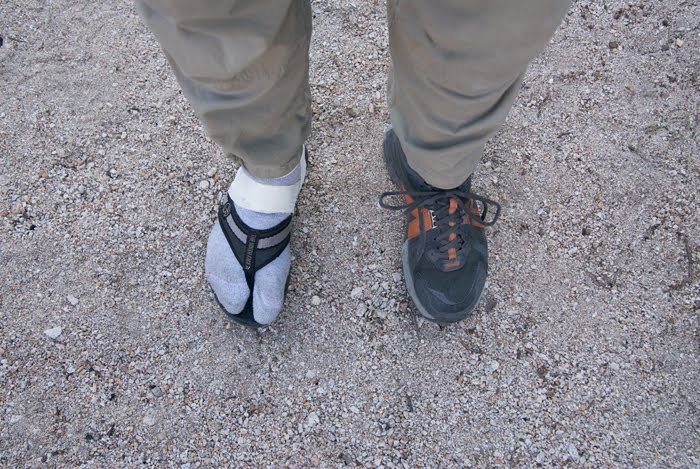
We roped up at noon and cruised up the perfect cracks and corners, doing the route in about six hours, arriving back in camp before dark. Somewhere between the summit down-climb and the rappels to the descent gully I managed to lose one of my approach shoes, so had to walk down in one climbing shoe. This was really a bummer as the shoes were pretty new, I'd just put some expensive insoles in them, and my feet were already screaming from the tight climbing shoes. The thought of hiking all the way back to the car with one shoe was undesirable. I did have a pair of flip flops with me and with some tape and a sock turned one into a nice sandal that got me all the way down without suffering much. If anyone finds that shoe I'd be happy to get it back!

(Outguard Spire on the right, Reggae Pole on the left)
Once down we had a swim in chilly Twin Lakes and burritos in town. So another excellent adventure and good times were had by all. New stories were made, to be told and retold around campfires in years to come.

Photos by Jerry Dodrill and Marty Roberts.
For more information about the Incredible Hulk, visit the route beta page at SuperTopo.com

Jerry Dodrill Photography
www.jerrydodrill.com