Sunday, August 8, 2010

Positive Vibrations


Last week I had the good fortune to climb one the finest rock climbs the Sierra has to offer: Positive Vibrations (5.11a). The route, just west of Bridgeport, CA, (five miles and 3000+' hike up Little Slide Canyon) is on a striking monolith of granite perfection known as The Incredible Hulk.
Marty Roberts and Rob McKay were perfect partners for this adventure. Several years ago Marty and I climbed a different route on the Hulk; the Red Dihedral. Marty has been traveling for the last year and was just getting back into the climbing groove. Rob is a super strong climber from here in Sebastopol who I have only just begun climbing with this year. Our plan was to hike in on Wednesday, climb Positive Vibes on Thursday as a party of three, then another friend, Eric Berghorn would show up to climb another route as two parties on Friday.
Jerry and Rob in base camp.

The trek up the trail, across beaver swamps, along the creek and over boulders was a beautiful trudge. We talked and laughed, catching up on old times and past climbs. Finally the Hulk came looming into view, luring us forward. Even from a mile away we could see the dark specks of other climbers high on the shimmering white tower. It was hard to fathom that tomorrow we would be high on that same face.
We got an intentional late start, waiting for the temps to warm up. About 10am we got started, Rob leading first, swapping leads as we went, with Marty following, self belaying on a mini-traxion.
Each pitch was spectacular and seemed even better than the previous.
Thin cracks, wide chimneys, splitter finger and hand cracks, and technical face moves all with tremendous exposure; Positive Vibrations has it all.
We inched our way up the wall, arriving on the summit before the sun went behind the ridge, then began a long series of rappels down the blank face.
Psyched on the summit, and rappelling in evening light.
We got back to camp just as darkness fell, still totally stoked. The stove roared to life and we ate an insane amount of food before collapsing exhausted under the stars.
Eric hadn't arrived and I was concerned about whether he had gotten the time off work. In the morning we slept in and lounged around eating, and drinking coffee. Feeling tired, we decided to hike out, so packed our bags. Just as we were leaving Eric arrived in camp, throwing a welcome kink in the plan. We had a war council and decided that because Eric had driven from Calistoga and hiked all the way in to climb with us, it wasn't really right to leave without him climbing something. So Rob and Marty bailed to climb in Tuolumne Meadows while Eric and I switched gears and did an afternoon ascent of Red Dihedral.
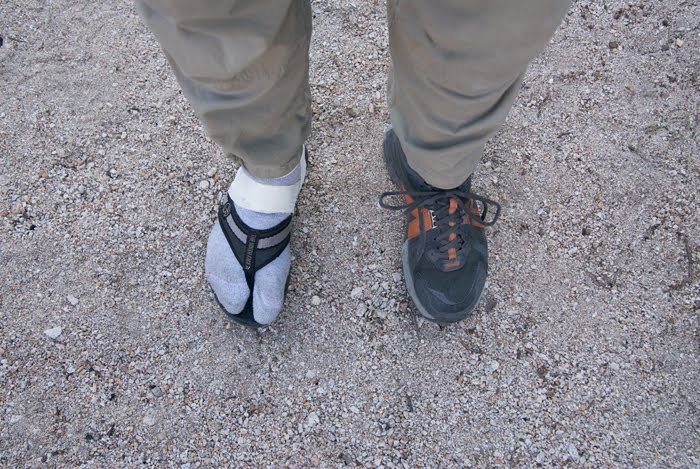
We roped up at noon and cruised up the perfect cracks and corners, doing the route in about six hours, arriving back in camp before dark. Somewhere between the summit down-climb and the rappels to the descent gully I managed to lose one of my approach shoes, so had to walk down in one climbing shoe. This was really a bummer as the shoes were pretty new, I'd just put some expensive insoles in them, and my feet were already screaming from the tight climbing shoes. The thought of hiking all the way back to the car with one shoe was undesirable. I did have a pair of flip flops with me and with some tape and a sock turned one into a nice sandal that got me all the way down without suffering much. If anyone finds that shoe I'd be happy to get it back!
(Outguard Spire on the right, Reggae Pole on the left)
Once down we had a swim in chilly Twin Lakes and burritos in town. So another excellent adventure and good times were had by all. New stories were made, to be told and retold around campfires in years to come.

Photos by Jerry Dodrill and Marty Roberts.
For more information about the Incredible Hulk, visit the route beta page at SuperTopo.com

Jerry Dodrill Photography
www.jerrydodrill.com

Thursday, July 22, 2010

End of the Road: New Idria


My wife and I were relaxing at Mercey Hot Springs in the Panoche Hills south of Mt. Diablo. I’m not very good at vacation and was scanning the map to eek out an adventure. Thirty miles away the road enticingly ended at “New Idria.” Those words were familiar. I’d read an account of this place in a book called Up and Down California in 1860-1864, the Journal of William H Brewer. Mr. Brewer was part Josiah Whitney's California Geologic Survey. In 1861 they journeyed to New Idria quicksilver mine on horseback:

"The view is extensive and peculiar... the Panoche Plain, with the mountains beyond–chain after chain of mountains, most barren and desolate. No words can describe it...gray and dry rocks or soil, furrowed by ancient streams into innumerable canyons, now perfectly dry, without a tree, scarcely a shrub or other vegetation–none, absolutely, could be seen. It was a scene of unmixed desolation, more terrible for a stranger to be lost in than even the snows and glaciers of the alps.”


Intrigued, Arienne and I spent the afternoon driving out the neglected road, stepping back in time, enjoying the vast openness, eventually winding our way up into the stark mountains.


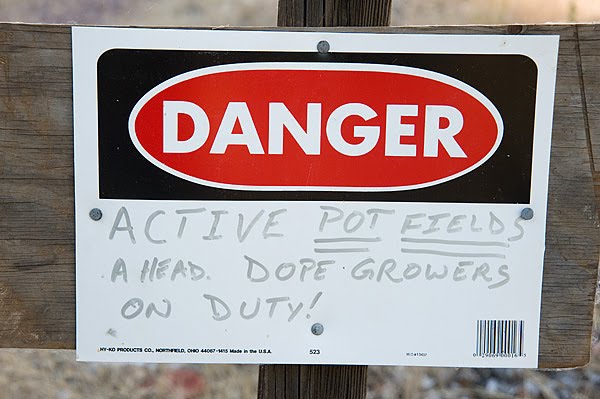
The road passed a number of ranches, turned to dirt and got steep before we finally we came to the Idria ghost town where the sign read:“Welcome to New Idria. Population: Me.” There were some other interesting signs as well. We had been told that despite the intimidation the road was public access and the often gun-weilding care-taker didn't have authority to run us off. (Though I don't tend to argue with flying bullets.)

This last sign was probably the greatest deterrent of them all.

There wasn’t a soul to be seen so we poked around a little bit, trying to avoid touching anything or breathing in the foul stench. There was a bad vibe in the air and it felt like something really terrible had happened here. The long bunk houses were trashed and filled with junk, windows smashed, doors kicked in, rats running around everywhere. The smell was horrendous. Arienne was smart enough to stay outside but I was fascinated by what looked like the set of a horror flick and ventured in for a moment.


Early Mexican, Chilean, Irish and Cornish migrant laborers earned just a couple dollars a day doing very dangerous jobs in the mine. Brewer wrote:

“Sulphurous acids, arsenic, vapors of mercury, etc., make a horrible atmosphere, which tells fearfully on the health of the workmen, but the wages always command men and there is no want of hands...”


The mine ceased production in 1972 and is now in a complicated state of bureaucracy between environmentalists, historians, government, and the current owner. The site has the unique distinction of being both a federal EPA Super Fund cleanup site and a California State Historical Site. The buildings are infected with the deadly hanta virus and need to be burned down, yet because of the historic status this cannot be done.
Just to add more complications, the Sierra Club has found some endangered species nearby, and the ground in the mountains is composed of asbestos, covered with poison oak, and crawling with rattlesnakes.

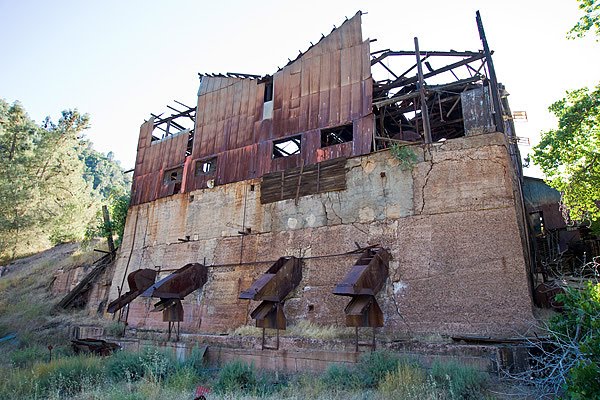
Rotary furnace building, built in 1917.
The website new-idria.org puts the situation in perspective:

"The New Idria Mercury Mine, the world's fourth largest quicksilver mine, became listed in the EPA's Comprehensive Environmental Response, Compensation, and Liability Information System (CERCLIS) database on April 16, 1996 because of the many complex environmental issues associated with this property's legacy as 115 years as a cinnabar mine and a mercury processing plant.

While there has been a good deal of study and concern about the pollution and contamination problems at New Idria, little has been done to begin remediation because the property owners lack the funds necessary for the environmental cleanup and hazard remediation. Regrettably, with several concerned environmental groups waiting in the litigation wings, it is doubtful that any well-off investor will purchase the property simply because litigation will begin the day after escrow closes."


New Idria was once a beacon of wealth and prosperity. But like other more current environmental disasters, the investors who prosper are quick to vanish leaving the aftermath for future generations. Brewer was accurate when he wrote:

“Such is New Idria and by such toils and sufferings do capitalists increase their wealth.”


-Jerry Dodrill

_____________________


For more info about New Idria: http://www.new-idria.org/

For a fascinating read about California history after the gold rush and during the civil war read:

Up and Down California in 1860-1864; The Journal of William H. Brewer


Jerry Dodrill

www.jerrydodrill.com

Thursday, April 29, 2010

Back to the East Side


I just never get tired of the Eastern Sierra. After driving all night last night I stumbled out of the car to just catch the moonset over Lone Pine Peak this morning. Over the next few days We'll be running up and down 395 chasing the light with John Shaw and the Mountain Light Workshop program. With all the recent storms we'll have some good material to work with.


Wednesday, February 3, 2010

Gallery Show in Bodega Bay


Local Color Gallery
1580 Eastshore Rd., Bodega Bay, CA

For the past ten years, Jerry Dodrill has been following the edge of light along California's North Coast. Chasing storms and fog, he seeks the dramatic moment when time and place weave into an ethereal fabric of color and texture. This exhibit features a mix of Jerry's most classic images and brand new work from Point Reyes to Del Norte Redwoods.

Thursday, August 27, 2009

Heaven and Earth


I enjoy a good glass of wine as much of as anyone else in wine country. Last year I photographed extensively for Red Car Wine in a few of their vineyards. After many months visiting the beautiful locations I still hadn't had even a sip of their fine wine. So in conversation with owner Carroll Kemp, and hoping to get my hands on a bottle or two, I inquired... "So how good is this wine?" He laughed and said, "The folks who do the ratings have been kind to us." Carroll later decided to start a new brand called
Heaven and Earth out of La Bohemé Vineyard, and used my photo on the label. I was quite honored! In July this year I heard that Heaven and Earth had been rated 97 out of 100 points by Wine Spectator; The highest grade ever given a California Pinot Noir. You can see a photo of the bottle on the cover (and inside) of the September 2009 issue of Wine Spectator Magazine, but good luck finding the wine. Only 292 cases were produced. I hear its pretty good and hope to get my hands on some...


Jerry Dodrill Photography
707-827-3547 Office
photo@jerrydodrill.com
http://www.jerrydodrill.com

Become a fan on facebook!

Monday, August 24, 2009


I was running late, driving too fast on a remote mountain road, and didn't have time to stop. Speeding around a corner, a new, strange sign caught my eye. "LOST BIRD." A couple corners later and I was still processing the scene. There wasn't a house in sight. I'm in the middle of a thick forest, and someone lost a bird? Gotta go back. I found a pullout and grabbed my camera.

"Takkun" the seven year old cockatiel was missing. I felt bad for the owner, yet wondered why they chose that spot to post the sign. I looked up and whistled toward the forest canopy. "Here there, pretty bird." Nothing.

Still intrigued, I later called the number on the sign.
"Hello, this is John."
"Uh, hi, I saw your sign... did you find the bird?"
"No, not yet. Its my daughter's bird. She's had it since she was seven. Its flown away a number of times but always came back. This time we're worried. He's so friendly we thought maybe someone would find him. "
"Do you live in the area?"
"Yeah, just up the hill."
Its getting a little awkward now, as I don't have a clue where his bird is and he doesn't get why I'm calling. I'm not sure either.
"Well, sorry to trouble you. Good luck."
"Thanks. Bye..."

So, if you find a cockatiel near St. Helena Road, there's a little girl who will be elated to see him again.

Saturday, July 11, 2009

Bishop with Muench and Mountain Light

It was a pleasure working with David Muench this last week. We were leading a five day photo workshop based out of Mountain Light Gallery in Bishop, California. The area offers a tremendous visual feast of natural wonders. To work here with one of the great landscape masters, exploring the desert and mountains, was an especially wonderful a treat. As usual, we were up early and late, often getting to bed at 11pm and leaving at 3:30 the next morning to catch magic light. Below are some photos I made during our field sessions. Monday afternoon we start another week long class, this time based in Lee Vining, where we'll visit the Ghost town of Bodie, Yosemite's high country, and Mono Lake.


To join a Mountain Light Workshop, or for information, visit http://www.mountainlight.com